
Party Lines; Future Delayed
Joe Biden and his allies are nearly unopposable for the nomination and that should bother you.

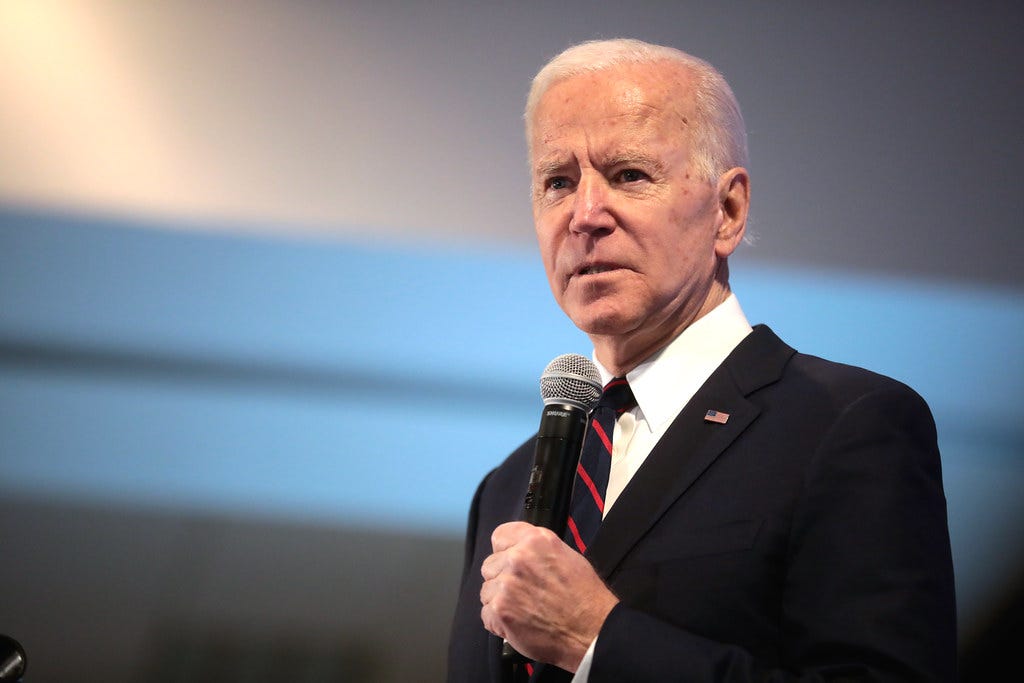
Back in 2019, Joe Biden announced his campaign in April. But he had been well-beaten to the punch: Bernie Sanders, Elizabeth Warren, Amy Klobuchar, and even Pete Buttigieg had already thrown their hats into that ring. Yet there was something unique about Biden: he had been polling in first place even before he announced his campaign. As the former Vice President, he had been seen as the obvious successor to Barack Obama, especially in the aftermath of Hillary Clinton’s lost campaign.
Back then his nomination was not set in stone. He lost the first two primaries in Iowa and New Hampshire. Buttigieg and Sanders were keeping up. It was not until the field cleared (including now-Secretary Buttigieg dropping out and endorsing Biden) that Biden’s path became clear.
We are now in April of 2023. The announced opposition to Biden is Robert F. Kennedy Jr, an anti-vaxxer, and Marianne Williamson, a visionary self-help author. Oh, and Joe Exotic, whose name should speak for itself.
The lack of a meaningful opponent to Joe Biden’s re-nomination bothers me. Let’s face the facts: Biden continues to struggle with approval ratings and is now 80 years old. He has been net-disapproved of for nearly two years. His net approval has been comparable to Trump’s for most of his Presidency and is much worse than Obama’s, whose approval rating sat around 0% to -3% around this same time into his term (compared to Biden’s roughly -10%).
Let me be clear: there is a lot for progressives to celebrate: progress on the Green New Deal most obviously.
The primary should offer a platform for the President to be accountable. Biden still has not met his promises to handle the refugee crisis. The cost of living has continued to increase while millions have been pushed off of Medicare. Biden intervened in the ongoing railway disputes, even against the wishes of the rail unions. He has a lot to answer for, yet, it is not clear if he will face any notable challenger (I doubt Kennedy or Williamson will get above 5%).
The Democratic party has made it harder, not easier, for fellow party members to challenge the incumbent. For example, the new primary schedule heavily favors South Carolina.
Biden and his allies claim that this is to make the early primaries more representative of the general populous. And this is true: South Carolina is certainly more representative than Iowa and New Hampshire.
But South Carolina is also notoriously conservative with only 15% of all adults identifying as liberal (when given three options: conservative, moderate, liberal). There is little reason beyond political favoritism to elevate South Carolina to be first instead of the most obvious contender: Georgia. Indeed, Georgia was the state that helped hand Biden the White House in the general election. Also, Georgia even has a greater proportion of Black, Hispanic, and Asian voters than South Carolina does.
By favoring South Carolina as the first in the horse race, Biden solidifies his headstart. It makes it harder to even get one’s foot in the door. The problem is not that it is impossible for anybody to meaningfully question the president, the problem is with it making it harder to do so.
If one has ever been worried about Trump’s influence over the GOP, then one should be worried about Biden’s grip over the DNC especially when the very method of nomination has been altered in his favor.
The American parties are meant to be big tents. Underneath each of the two parties, many different groups should be able to have a voice. The progressives are now the largest Congressional caucus and have been gaining support steadily since Sander’s 2016 campaign. So why is the DNC trending toward favoring conservative states in the primary cycle over states where progressive candidates have done well? It only makes sense if we account for Biden and his allies wanting to favor Biden’s own clearest path.
I do not think Biden would lose a contested primary. The incumbent always has an advantage and people know Joe Biden and would likely vote for him. But being able to hold the President accountable to other wings of the party is important.
There is a further problem in the Democratic party: there is not a clear future for the leadership. Kamala Harris, too, is unpopular with a net approval rating of negative 13%. The youngest person to make a name for himself at the national level was Pete Buttigieg with his unexpectedly strong primary campaign. But he is not without criticism: he was criticized early on for being unqualified for his current position (Secretary of Transportation), to which he responded that he has always liked trains. Likewise, he has been criticized for his response to the East Palestine trail derailment.
The national stage is where the future of the party should be clarified, not pushed down. We cannot hope for an inspiring new generation of political leaders if they are not allowed the pursue the national stage and have their concerns heard.
When the future of the nation is on the line, we cannot have the biggest name possibly challenging Biden be somebody like Joe Manchin. Biden and Manchin should not decide, on their own, the future of the Democratic party.
It is a good thing for the President to be accountable to the new generations of rising leaders. Biden should be held more accountable for his shortcomings; part of this should be him facing a serious challenger given his unpopularity. If that is not what a democracy is about, then the Democrats should adopt a new name.
I think the fact that you discount Williamson and RFK Jr. is part of the exact problem that you seem to be diagnosing. The conventional idea of a "serious" and "qualified" candidate is part of the exact same paradigm that got us into this mess.
Williamson is far better at articulating the problems facing Americans today, understands the necessary solutions, and has far more credibility on actually implementing them. Even during the 2020 campaign, her website had by far the most robust policy prescriptions of the newcomers. Early on, her policy portfolio was more robust than Warren or Sanders.
Reducing RFK to "anti-vax" views is also a dangerous oversimplification. Not to do his PR work for him, but he is not against vaccines. He is skeptical of the central role they play in modern medicine, and especially the role of pharmaceutical companies in determining public health policy - a skepticism that's sorely needed. I'm not a scientist but even if everything he said about vaccines is nonsense, that hardly seems like that's the most significant aspect of him or his campaign.
On the most important issue facing the world today - the US proxy war in Ukraine and the surrounding international response - RFK's position is far and away more informed and coherent than what appears in most American media. It's still crazy that saying "we should move to end the bloodshed in Ukraine" is treated like a pariah. Whenever someone polling at 14% is talking about rolling back the US empire and breaking up the CIA, sensible people ought to listen. His family name and history only make the situation more interesting.
Of course I'm skeptical of the man: Among other things, he has a former CIA officer on his campaign staff. Who knows whether or not he'll be running a serious campaign.
While I largely think presidential politics is a dead end and a waste of time (DNC can quite literally do whatever they want as they successfully argued in court), it does offer the chance to recalibrate our priorities and values, which always makes for interesting discussion. Win or lose, the case of Biden's challengers will tell us a lot about what the next half decade of American politics will look like.